Equivariant Image Representation via Gaussian Splats
Exploration of Gaussian Splatting as an alternative to pixel-wise image representation.
Supervisor: Fabio Brau Suitable for: Bachelor’s, Master’s, or PhD students (the project scales — see Objectives) Areas: computer vision, image representation, geometric deep learning
Overview
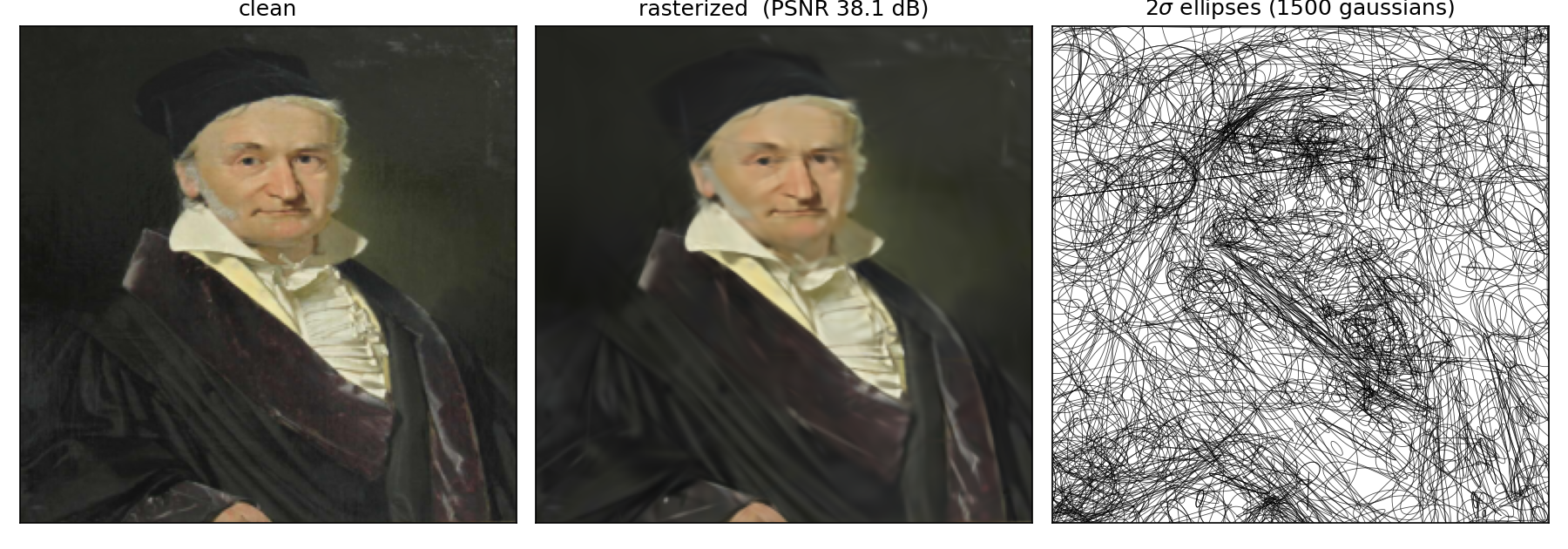
Pixel-wise image representation is the undisputed standard: fast, intuitive, and GPU-friendly. This project explores Gaussian Splatting (GS) as a structured, equivariant alternative to pixels. Because GS has clean geometric structure, it admits a natural metric and supports architectures that respect its symmetries (shifting, rotation, and zoom). A student joining this project would work at the intersection of image representation and geometric deep learning, building the GS representation and equivariant models that operate directly on it.
What you would work on
Depending on your level and interest, you would take on one (or a sequence) of the objectives below. They are ordered from most accessible to most challenging, and each one builds on the previous: representation → its symmetries → a metric on those symmetries → architectures honoring the metric. This means the project can be entered at the right level for a Bachelor’s, Master’s, or PhD student, and a strong student can carry it further.
Background
The representation rests on two core definitions.
Definition 1 (Gaussian Splat). Let $\Sigma \in \mathbb{R}^{2\times 2}$ be a positive definite matrix and let $\mu \in \mathbb{R}^2$ be a vector. The Gaussian splat is
\[g_{\mu,\Sigma}(x) = \frac{1}{2\pi \det \Sigma} \exp\left(-\frac{1}{2}(x-\mu)^T \Sigma^{-1}(x-\mu)\right)\]Definition 2 (Gaussian Splatting). Given a vector space of colors $\mathcal{C}$ (for simplicity $\mathcal{C} = \mathbb{R}^3$), a Gaussian Splatting of finite length $N$ is a sequence of tuples ${(g_j, c_j, \alpha_j)}_{j=1,\dots,N}$, where each $g_j$ has the form above, $c_j \in \mathcal{C}$, and $\alpha_j > 0$. The represented image is
\[\mathcal{G}(x) = \frac{\sum_{j=1}^N \alpha_j\, c_j\, g_j(x)}{\sum_{i=1}^N \alpha_i\, g_i(x)}\]Representation of $\Sigma$. Since $\Sigma$ is symmetric positive definite, it factors into an anisotropic scaling and a rotation:
\[S = \begin{bmatrix} a & 0 \\ 0 & b \end{bmatrix}, \quad R = \begin{bmatrix} \cos\theta & -\sin\theta \\ \sin\theta & \cos\theta \end{bmatrix}, \quad \Sigma = (RS)(RS)^T = R S S R^T\]This yields $\det(\Sigma) = a^2 b^2$ (Binet’s formula) and
\[\Sigma^{-1} = R \begin{bmatrix} \frac{1}{a^2} & 0 \\ 0 & \frac{1}{b^2} \end{bmatrix} R^T\]This $(\mu, a, b, \theta)$ parameterization is what Objective 1 formalizes, and the rotation/scaling structure is precisely what makes the equivariance properties of Objective 2 tractable.
Objectives
Objective 1 — Build and validate the 2D Gaussian Splatting representation
Formalize the GS image model and the parameterization of $\Sigma$ via rotation and anisotropic scaling, then verify that real images can be reconstructed at acceptable fidelity. Largely definitional and reconstructive, building on existing work such as GaussianImage. Low risk; produces the substrate everything else depends on.
- Estimated time: 2–3 months
- Suitable for: Bachelor’s thesis
Objective 2 — Characterize the equivariance properties of the representation
Prove formally that GS is equivariant under shifting, rotation, and zoom. Requires careful theory but is self-contained, establishing the symmetry structure that later work builds on.
- Estimated time: 3–4 months
- Suitable for: Master’s thesis (combined with Objective 1)
Objective 3 — Equip the splat parameter space with a hyperbolic metric
Motivate and define a hyperbolic metric structure on the splat parameters, and show it is well-defined and compatible with the equivariance group from Objective 2. The first genuinely novel theoretical contribution and the conceptual core of the work.
- Estimated time: 5–7 months
- Suitable for: PhD chapter / workshop paper
Objective 4 — Design neural architectures equivariant to the GS transformations
Construct networks that operate directly on splats and respect the symmetry group. A theory-plus-engineering objective depending on Objectives 2 and 3.
- Estimated time: 6–9 months
- Suitable for: PhD chapter / conference paper
At a glance
| # | Objective | Estimated time | Suitable for |
|---|---|---|---|
| 1 | Build and validate the 2D GS representation | 2–3 months | Bachelor’s thesis |
| 2 | Characterize equivariance properties | 3–4 months | Master’s thesis (with Obj. 1) |
| 3 | Equip parameter space with hyperbolic metric | 5–7 months | PhD chapter / workshop paper |
| 4 | Design equivariant neural architectures | 6–9 months | PhD chapter / conference paper |
How to apply
If this project interests you, get in touch with Fabio Brau with a short note about your background and which objective appeals to you most. Mentioning relevant coursework or projects (computer vision, deep learning, geometry) is helpful.